Wednesday, 30 April 2014

Tuesday, 29 April 2014
Final Film Poster

However, I need to develop this poster further by making use of the empty space and to create more connotations of a crime film in the poster.
Monday, 28 April 2014
Sunday, 27 April 2014
Evaluation 1
In what ways does the media product use, develop
or challenge forms and conventions of real media products?
We were able to maintain conventions of continuity by using technology such as final cut pro to edit our film. This enabled us to cut together our film using continuity editing by using match on actions and shot reverse shots and by obeying the 180 degree line rule. Because of this our film maintains continuity, allowing our film to run smoothly meaning that a disruption in continuity would ruin an audience's suspension of disbelief.
 |
| This is an example of how we followed the 180 degree line rule to maintain continuity in our film. |
 |
| By maintaining continuity, it allows an audience to not become disorientated with the film. |
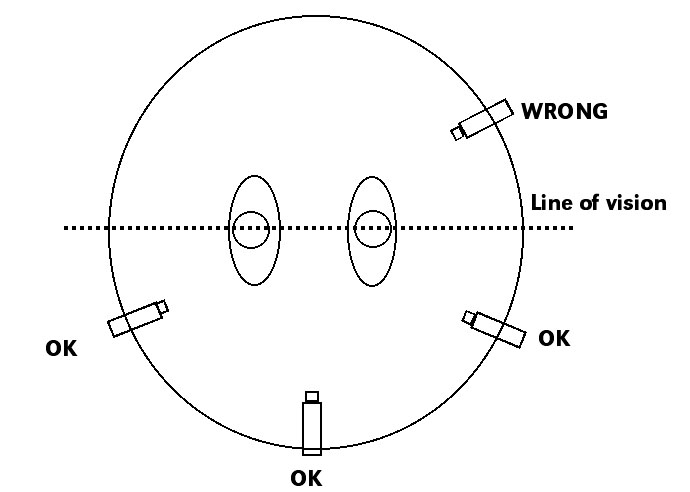 |
| this is a diagram of how the 180 degree line rule works. |
 |
| This is an example of the 180 degree line rule used in a movie. |
As well as this, we used editing technology to enhance our film. We used it to add sound effects and music to make the film more atmospheric, as well as by adding visual effects to make how film look more like conventional, professionally produced films.
 |
| This is an example of final cut pro being used to edit our film. It allowed us to create a more professional-looking product. |
In terms of content, how film is somewhat conventional of a gritty crime thriller. It takes place in an urban setting, and uses a male cast. The committing of a crime is a key theme throughout the film, as well as the repercussions of the event. I do not feel that our film would subvert the audience's expectations of what they expect to see when viewing a crime film.
There is 1 shot in our film that is a deliberate, direct pastiche / reference to Quentin Tarantino. This shot is the trunk shot at the beginning of the film. This is a reference to Quentin Tarantino because he uses trunk shots in all his films, such as reservoir dogs and pulp fiction. We also use a time lapse in our film to show progression of time. I feel this is a reference to many other films / TV such as Breaking Bad and House of Cards.
These are the time lapses that inspired us when we tried to film our time lapse to show a progression of time between two acts.
I believe an audience pleasure our film attempts at providing is entertainment. By having an entertaining, exciting film our audience will get pleasure and escapism in our film.
In addition to this, I feel our film complies with some of Richard Dyer's theories on entertainment and utopia. He believes there are certain utopian sensibilities in films that allows an audience to lose themselves in the film. I think the sensibilities that comply with our film are energy because our film is fast paced and has action, and intensity because our film contains high highs (pulling off a robbery and not getting caught) and low lows (the rookie killing his partner).
I also think we have community in our film, showing the relationship and partnership between rookie and boss.
 |
| Our film uses two male actors - which is extremely conventional of a film in the crime-thriller genre. |
 |
| The establishing shot we used at the beginning of the film helps to establish the urban setting where our film takes place. |
There is 1 shot in our film that is a deliberate, direct pastiche / reference to Quentin Tarantino. This shot is the trunk shot at the beginning of the film. This is a reference to Quentin Tarantino because he uses trunk shots in all his films, such as reservoir dogs and pulp fiction. We also use a time lapse in our film to show progression of time. I feel this is a reference to many other films / TV such as Breaking Bad and House of Cards.
 |
| This is one of Quentin Tarantino's 'signature' shots that we incorporated into our film as a reference to the director. |
 |
| This is our version of the trunk shot that we filmed. It was difficult to get the framing right, given the logistics of filming in a car. |
These are the time lapses that inspired us when we tried to film our time lapse to show a progression of time between two acts.
 |
| Inspired by the time lapses we found, this is our version of a time lapse, used to show a progression of time. |
I believe an audience pleasure our film attempts at providing is entertainment. By having an entertaining, exciting film our audience will get pleasure and escapism in our film.
In addition to this, I feel our film complies with some of Richard Dyer's theories on entertainment and utopia. He believes there are certain utopian sensibilities in films that allows an audience to lose themselves in the film. I think the sensibilities that comply with our film are energy because our film is fast paced and has action, and intensity because our film contains high highs (pulling off a robbery and not getting caught) and low lows (the rookie killing his partner).
 |
| The heist scene is a an example of an energetic scene during our film when we see the character's partake and pull off a robbery. |
 |
| The previous scenes in our film then contrasts with the bleak conclusion for one of our characters. It helps to create an intense rollercoaster ride for an audience, with high's and low's during our film. |
I also think we have community in our film, showing the relationship and partnership between rookie and boss.
 |
| An example of the relationship between the rookie and boss, relating to Richard Dyer's theory of entertainment and Utopia. |
Saturday, 26 April 2014
Friday, 25 April 2014
Evaluation 3
What have you learned from your audience
feedback?

 |
| I made a pie chart showing what age certificate our audience believed our film should get from our questionnaire. This shows that our audience believe our film isn't suitable for anybody under 15. Because of this, we were able to included more mature / adult themes such as strong language and violence |
 |
| This pie chart illustrates how easy to understand how film's narrative is. By having an understandable narrative, we were able to convey all the messages we wanted to include in our film. |
 |
| This pie chart showed whether or not the people who answered our questionnaire enjoyed our film. This proved our film was a success. |
Thursday, 24 April 2014
Evaluation 4
How did you use new media technologies in the
construction and research, planning and evaluation stages?
We used new media technologies in the construction process of creating our film. An example of this was when we used camcorders to film our film. The cameras we used were the Sony HD1000 - this allowed us to capture a high-quality film which made the film look professional. In addition to this, we used zoom recorder audio recording device to record a voice over our film. By using a dedicated device to do this, we were able get a high-quality crisp voice over for our film. We were able to apply this to the ending of our film, and use it in our radio trailer.
 |
| This was the Sony HD1000 that we used in our filming process. By using a tripod with the camera, we were able to capture still, professional, high quality shots. |
 |
| This was the Zoom Recorder that we used in our sound recording process. We also used the zoom recorder to record our radio trailer. It gave us a more professional-sounding radio trailer, rather than using other devices such as cameras or mobile phones. |
 |
| This was an example of how we used final cut pro to be more creative in our film. In this example we wanted to create a time lapse to show a progression of time. We filmed a 5 minute still establishing shot and sped the clip up. In addition to this, we applied a widetime effect to show the blurred effect on movement. |
We also used Adobe Photoshop in the construction process of our media product. We used Adobe Photoshop to design the film production company logo and the poster to promote our film. |
 |
| I used Adobe Photoshop Elements to design the two posters. As a graphic design student, I felt comfortable using Photoshop, although the version we had to use in Media was elements, so I thought it was more limited in terms of being creative because of the lack of effects / features available. |
 |
| Because of this, I used Adobe Photoshop CS5 to design our film poster. This allowed me to be more creative because I already knew the features and how to use the software. It also allowed me to be more efficient when designing the poster. I didn't have to spend as much time designing the poster because I knew how to navigate the software and the shortcuts. |
 |
| Using the internet, we used IMDB to look at similar films which gave us an insight on conventions of crime films helped us design our film. |
 |
| In addition to using IMDB to research similar films, we used the internet to research existing radio trailers. Because it was hard to find examples of radio trailers by listening to radio stations, the internet was extremely useful by allowing us to access existing radio trailers on-demend. This gave us ideas and inspiration for when we produced our radio trailer. |
 |
| The internet was also useful by providing us a way to look at a range of film posters allowed us to incorporate the conventions from film posters into our film poster which resulted in our group producing an professional film poster.
We also used Google Docs to to conduct audience research
|
 |
| We designed a questionnaire about our film, designed to ask our audience what for feedback on our film, to see if we achieved our initial targets. Google Docs was useful in this scenario because we could embed it into our blog and we could distribute it via social networks. |
 |
| Another positive thing about Google Docs was that it stored all the results for us, allowing us to easily see our feedback. |
We used new media technologies to help us in the pre-production / planning stage in our film because we were able to use Celtx to produce a script for our film.
 |
| Using Celtx to produce a script for a film allowed us to produce an easy-to-understand, functional script for our film. |
We also used blogger as a tool to completely plan our film. We used blogger to act as a platform to host all our planning materials, such as scripts and shot lists. Because of this, we could access these materials on a variety of platforms such as on our computers at home, or on our mobile phones. This proved as a valuable resource when we were out filming our film.
 |
| Blogger was really useful in the planning and evaluation stages of our media product. It was useful because it was easy to navigate between posts. |
For our evaluation process, we used a variety of new media technologies to help us illustrate what we think of our film. We used blogger to form an essay which was useful because it contains tools to embed images and videos which helped us illustrate our points more. We also used slideshare to present information.
 |
| I also used prezi in our evaluation process. I liked how it was easy to design a flowing presentations to help get across my thoughts on how our production combined with our ancillary texts. It allowed me to embed videos and images into the prezi and allowed me to control the 'camera' on the presentation to I could control the navigation of the prezi. This was more convenient than using conventional presentation software, such as Microsoft Powerpoint because sometimes you have to compromise image size or text amount when using that software. |
Friday, 4 April 2014


Tuesday, 1 April 2014
Subscribe to:
Comments (Atom)